
Projects
ASE
Background
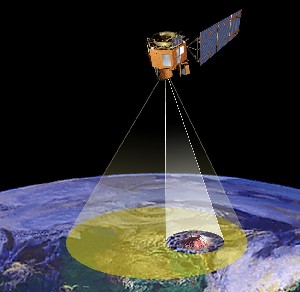
Since the dawn of the space age, unmanned spacecraft have flown blind with little or no ability to make autonomous decisions based on the content of the data they collect. The Autonomous Sciencecraft Experiment (ASE) is operating onboard the Earth Observing-1 mission since 2003. The ASE software uses onboard continuous planning, robust task and goal-based execution, and onboard machine learning and pattern recognition to radically increase science return by enabling intelligent downlink selection and autonomous retargeting. This software demonstrates the potential for space missions to use onboard decision-making to detect, analyze, and respond to science events, and to downlink only the highest value science data.
Problem
Constrained downlink resources limit the science return of current and future space missions.
Impact
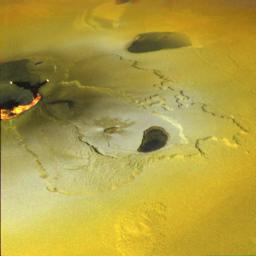
Short-Lived Eruption on Io
Demonstration of these capabilities in a flight environment opens
up tremendous new opportunities in planetary science, space physics,
and earth science that would be unreachable without this technology.
This technology:
- Dramatically increases the science per fixed downlink by
enabling downlink of the highest priority science data.
- Enables study of short-lived science events (such as volanic
eruptions, dust storms, etc.)
- Reduces downtime lost to anomalies due to robust execution
enabled by autonomy software.
- Reduces instrument setup time by using autonomy software take
advantage of execution information to streamline operations.
Status
EO-1 was decomissioned in Spring 2017.Mission Total
Images Taken: 67104
Sensorweb: 5971
Science Scenarios Executed: 1470
Positive Triggers: 257
Ground Contacts: 61325
X-Band: 22787
S-Band: 38538
Description
+ ASE Mission Concept AnimationA typical ASE demonstration scenario involves monitoring of active
volcano regions such as Mt. Etna in Italy. Hyperion data have been
used in ground-based analysis to study this phenomenon.
The ASE
concept is applied as follows:
-
- Initially, ASE has a list of science targets to monitor that
have been sent as high-level goals from the ground.
- As part of normal operations, CASPER generates a plan to monitor the targets on this list by periodically imaging them with the Hyperion instrument. For volcanic studies, the IR and near IR bands are used.
- During execution of this plan, the EO-1 spacecraft images Mt. Etna with the Hyperion instrument.
- The onboard science algorithms analyzes the image and detects a fresh lava flow. Based on this detection the image is downlinked. Had no new lava flow been detected, the science software would generate a goal for the planner to acquire the next highest priority target in the list of targets. The addition of this goal to the current goal set triggers CASPER to modify the current operations plan to include numerous new activities in order to enable the new science observation.
- The SCL software executes the CASPER generated plans in conjunction with several autonomy elements.
- This cycle is then repeated on subsequent observations.
Publications
Team
Jet Propulsion Laboratory:Steve Chien
Rob Sherwood
Becky Castano
Ashley Davies
Gregg Rabideau
Daniel Tran
Ben Cichy
Nghia Tang
Rachel Lee
Russell Knight
Steve Schaffer
NASA Goddard Space Flight Center:
Dan Mandl
Stuart Frye (Mitretek)
Seth Shulman (Honeywell-TSI)
Joe Szwaczkowski (Honeywell-TSI)
Josh Bowman (Adnet)
Rob Bote
Interface and Control Systems: Darrell Boyer
Jim VanGaasbeck
Microtel: Bruce Trout
Nick Hengemihle
Jerry Hengemihle
the Hammers Company: Jeff D'Agostino
Kathie Blackman
Arizona State University: Ronald Greeley
Thomas Doggett
University of Arizona: Victor Baker
James Dohm
Felipe Ip
Center for Earth and Planetary Studies
National Air and Space Museum
Smithsonian Institute: Kevin Williams